Total Pageviews

Monday, September 18, 2017

Dieu et la Création du Monde, Admirable Leaders and Companies, Sinergy

Comment créer une entreprise admirable (Ou comment créer le monde)


Les métaphores aident à tout comprendre. Une métaphore puissante et commune se réfère à la création du monde. Dans toutes les religions, il y a un dieu qui a créé le monde, un démiurge qui n'a trouvé en rien les éléments qui ont façonné le monde. Dans une entreprise, il existe aussi un démiurge qui crée (= obtient) des choses comme l'infrastructure, l'argent, les gens; il ordonne et établit des mécanismes qui permettent la création de valeur (vision, marque, part de marché, engagement des salariés)

Le chef n'est pas tout-puissant comme le dieu qui obtient des choses ou des résultats de rien; mais il a à sa disposition les éléments nécessaires pour construire son excellent travail, la grande organisation ou la grande entreprise. Dans les religions occidentales, on dit que le monde a été créé en cinq jours et, le sixième jour, l'homme a été créé; Dans les organisations, le leader est placé sur le «sixième jour» pour construire son organisation. Le dieu créateur a respiré ou induit la vie dans ses créatures, le chef enfonce l'esprit de grandeur dans son organisation.

Dans les organisations, les décisions dépendent des patrons, des commandants, des présidents, des rois ou autres; mais seulement un leader inspirant peut mener et former une organisation formidable, une grande armée, un grand pays ou un royaume.

Dans la création il y a deux éléments, la formule magique et la volonté; la capacité de création est implicite. La volonté, du point de vue humain, est la capacité humaine de décider librement de ce qui est recherché et de ce qui ne l'est pas. C'est le désir ou l'intention, la capacité de décider et de commander son comportement pour obtenir des résultats, et être conscient de cela.

Supposons que dans une entreprise, il y a deux groupes de personnes: les millénaires et les fidèles collaborateurs. Les attributs ne sont pas exclusifs car il peut y avoir des «millénaires loyaux», mais la plupart ne le sont pas (une qualité acceptée par le millénaire). Dans le cadre de la probabilité, la somme des valeurs ne dépasse pas 1 (formule 1).


Lorsque nous considérons une attitude, un comportement, une condition exprimée par la volonté, la formule précédente ne fonctionne pas, car la somme peut être supérieure à 1 si l'action conjointe est positive; ou moins de 1 si cet acte est négatif. Dans le premier cas, il est évident qu'il existe un leader qui obtient Synergy des ressources disponibles; dans l'autre cas, il révèle un patron médiocre ou destructif, qui ne sait pas et ne peut pas tirer le meilleur parti des ressources disponibles. Pour la simplicité, deux composants, A et B, ont été présentés; pour un plus grand nombre, le concept est similaire et la formule est complexe mais ne change pas l'essence de l'interprétation.


La force de ces formules dépend de ceux qui les utilisent ou les formulent. Le créateur des mondes a la volonté et le pouvoir, le pouvoir de sortir les choses, de vouloir infuser la vie et de commander leur fonctionnement; Le leader a également le pouvoir et la volonté. Le pouvoir est exprimé par la capacité d'acquérir des actifs grâce à un crédit financier et de commander le recrutement de talents pour l'entreprise, la volonté se manifeste dans la commande et la création de relations pour obtenir une collaboration et un engagement maximaux. Le dieu créateur et le leader utilisent la formule 2, dans laquelle il n'y a pas d'exclusion. Un dieu avec une puissance ou une vision limitée est limité à la formule 1 et produit un tas de choses; tout patron fait de même et finit par détruire la valeur dans l'entreprise. Les dirigeants sont des démiurges, les patrons ne sont jamais.

La métaphore de la création du monde s'exprime dans une phase simple; Fiat lux (laissez-le léger); le processus de création d'une entreprise puissante s'exprime par la «formule» de la synergie: 1 + 1 = 3. Un dieu qui a le pouvoir et la volonté de créer des mondes; un leader qui emploie la volonté de créer une excellente entreprise. Les deux s'ajoutent toujours.


Gott und die Schöpfung der Welt, bewundernswerte Führer und Firmen, Sinergy

Wie man ein bewundernswertes Unternehmen schafft (Oder wie man die Welt erschafft)


Metaphern helfen, alles zu verstehen. Eine mächtige und gemeinsame Metapher bezieht sich auf die Schaffung der Welt. In allen Religionen gibt es einen Gott, der die Welt erschaffen hat, ein Demiurge, der in nichts die Elemente fand, die die Welt prägten. In einer Gesellschaft gibt es auch einen Demiurge, der (wie bekommt) Dinge wie Infrastruktur, Geld, Menschen schafft; es ordnet und richtet Mechanismen, die die Schaffung von Wert (Vision, Marke, Marktanteil, Engagement der Mitarbeiter)

Der Führer ist nicht allmächtig wie der Gott, der Dinge oder Resultate aus dem Nichts bringt; aber er hat zur Verfügung die notwendigen Elemente, um seine große Arbeit, die große Organisation oder große Gesellschaft zu bauen. In den westlichen Religionen heißt es, dass die Welt in fünf Tagen erschaffen wurde und am sechsten Tag der Mensch erschaffen wurde; in Organisationen wird der Führer auf den "sechsten Tag" gesetzt, um seine Organisation zu bauen. Der Schöpfer Gott atmete ein oder veranlasste das Leben in seinen Kreaturen, der Führer infundiert den Geist der Größe in seine Organisation.

In Organisationen hängen Entscheidungen von den Chefs, Kommandanten, Präsidenten, Königen oder was auch immer; aber nur ein inspirierender Führer kann führen und bilden eine große Organisation, eine große Armee, ein großes Land oder Königreich.


In der Schöpfung gibt es zwei Elemente, die magische Formel wird; die Fähigkeit zur Schöpfung ist implizit. Der Wille ist aus menschlicher Sicht die menschliche Fähigkeit, frei zu entscheiden, was gewünscht wird und was nicht ist. Es ist der Wunsch oder die Absicht, die Fähigkeit zu entscheiden und das Verhalten zu beurteilen, um Ergebnisse zu erzielen und sich dessen bewusst zu sein.

Angenommen, in einer Gesellschaft gibt es zwei Gruppen von Menschen: Die Jahrtausende und die loyalen Mitarbeiter. Attribute sind nicht exklusiv, weil es "loyale Jahrtausende" geben kann, aber die meisten nicht (eine Qualität, die von den Jahrtausenden akzeptiert wird). Im Rahmen der Wahrscheinlichkeit überschreitet die Summe von Werten 1 (Formel 1) nicht.


Wenn wir eine Haltung betrachten, ein Verhalten, eine Bedingung, die durch den Willen ausgedrückt wird, funktioniert die vorhergehende Formel nicht, weil die Summe größer als 1 sein kann, wenn der Akt der gemeinsamen Aktion positiv ist; oder weniger als 1, wenn diese Handlung negativ ist. Im ersten Fall ist es offensichtlich die Existenz eines Führers, der Synergie aus den verfügbaren Ressourcen erhält; im anderen Fall zeigt es einen mittelmäßigen oder zerstörerischen Chef, der nicht weiß und nicht die besten verfügbaren Ressourcen bekommen kann. Zur Vereinfachung wurden zwei Komponenten, A und B vorgestellt; Für eine größere Zahl ist das Konzept ähnlich und die Formel ist komplex, verändert aber nicht das Wesen der Interpretation.


Die Stärke dieser Formeln hängt davon ab, wer sie benutzt oder formuliert. Der Schöpfer der Welten hat Wille und Macht, Macht, die Dinge aus dem Nichts herauszuholen, bereit, das Leben zu infundieren und ihre Funktionsweise zu ordnen; Der Führer hat auch Macht und Willen. Macht wird durch die Fähigkeit ausgedrückt, Vermögenswerte durch eine finanzielle Kredit zu erwerben und die Rekrutierung von Talente für das Unternehmen zu bestellen, der Wille manifestiert sich in der Bestellung und die Schaffung von Beziehungen, um maximale Zusammenarbeit und Engagement zu erhalten. Der Schöpfergott und der Führer verwenden die Formel 2, in der es keinen Ausschluss gibt. Ein Gott mit begrenzter Macht oder Vision ist auf Formel 1 beschränkt und produziert einen Haufen von Dingen; jeder Chef tut das gleiche und endet Zerstörung Wert in der Firma. Führer sind Demiurges, Chefs sind nie.

Die Metapher der Schöpfung der Welt wird in einer einfachen Phase ausgedrückt; Fiat lux (lass es Licht geben); Der Prozess der Schaffung eines mächtigen Unternehmens wird durch die "Formel" der Synergie ausgedrückt: 1 + 1 = 3. Ein Gott, der die Kraft und den Willen hat, Welten zu erschaffen; ein Führer, der den Willen beschäftigt, ein großes Unternehmen zu schaffen. Die beiden addieren sich immer.


God and Creation of the World, Admirable Leaders and Companies, sinergy

How to create an admirable company (Or How to create the world)


Metaphors help to understand everything. A powerful and common metaphor refers to the creation of the world. In all religions there is a god who created the world, a demiurge who found in nothing the elements that shaped the world. In a company there is also a demiurge who creates (= gets) things like infrastructure, money, people; it orders and establishes mechanisms that allow the creation of value (vision, brand, market share, commitment of employees).

The leader is not all-powerful as the god who gets things or results out of nothing; but he has at his disposal the necessary elements to build his great work, the great organization or great company. In Western religions, it is said that the world was created in five days and on the sixth day man was created; in organizations, the leader is placed on the "sixth day" to build his organization. The creator god breathed in or induced life in his creatures, the leader infuses the spirit of greatness into his organization.

In organizations, decisions depend on the bosses, commanders, presidents, kings or whatever; but only an inspiring leader can lead and form a great organization, a great army, a great country or kingdom.


In creation there are two elements, the magic formula will; the capacity for creation is implicit. The will, from the human point of view, is the human capacity to decide freely what is wanted and what is not. It is the desire or intention, the ability to decide and order one's behavior to achieve results, and be aware of it.
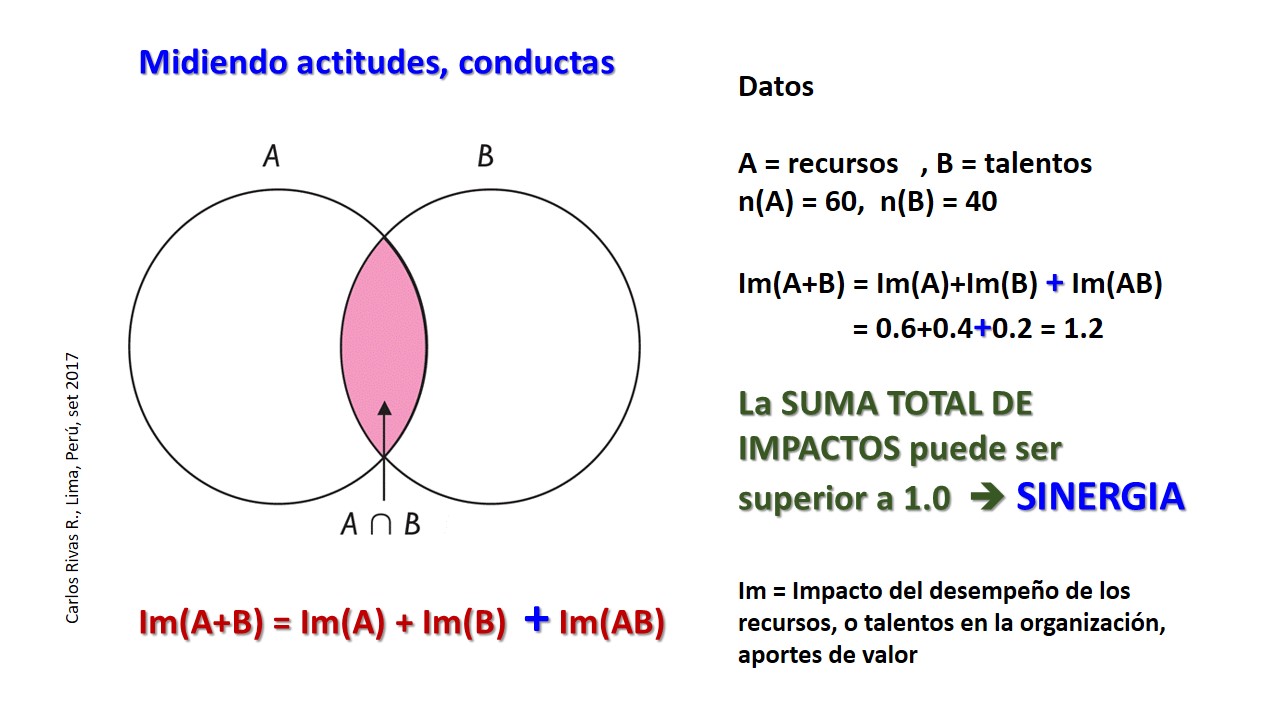
Suppose in a company there are two groups of people: The millennials and the loyal collaborators. Attributes are not exclusive because there may be "loyal millennials", but most do not (a quality accepted by the millennial). In the scope of probability, the sum of values ​​does not exceed 1 (formula 1).


When we consider an attitude, a behavior, a condition expressed by the will, the previous formula does not work, because the sum can be greater than 1 if the act of joint action is positive; or less than 1 if this act is negative. In the first case, it is evident the existence of a leader who obtains Synergy from the resources available; in the other case, it reveals a mediocre or destructive boss, who does not know and can not get the best of available resources. For simplicity two components, A, and B, were presented; for a greater number the concept is similar and the formula is complex but does not change the essence of interpretation.


The strength of these formulas depends on who uses them or formulates them. The creator of worlds has will and power, power to get things out of nothing, willing to infuse life and order their functioning; the leader also has power and will. Power is expressed through the ability to acquire assets through a financial credit and order the recruitment of talents for the company, the will manifests itself in ordering and creating relationships to obtain maximum collaboration and commitment. The creator god and the leader use formula 2, in which there is no exclusion. A god with limited power or vision is limited to formula 1 and produces a pile of things; any boss does the same and ends up destroying value in the company. Leaders are demiurges, bosses are never.

The metaphor of the creation of the world is expressed in a simple phase; Fiat lux (let there be light); the process of creating a powerful company is expressed by the "formula" of synergy: 1 + 1 = 3. A god who has the power and the will to create worlds; a leader who employs the will to create a great company. The two always add up.


Dios y creación del mundo, líderes y empresas admirables , sinergia

Como crear una empresa admirable (O Como crear el mundo)


Las metáforas ayudan a entender todo. Una metáfora poderosa y común se refiere a la creación del mundo. En todas las religiones existe un dios creador del mundo, un demiurgo que encontró en la nada los elementos que dieron forma al mundo. En una empresa también existe un demiurgo que crea (=obtiene) cosas como la infraestructura, dinero, personas; los ordena y establece mecanismos que permitan la creación de valor (visión, marca, participación de mercado, compromiso de colaboradores)

El  líder no es todopoderoso como el dios  que obtiene cosas o resultados a partir de la nada; pero tiene a su  disposición los elementos necesarios para construir su gran obra, la gran organización o gran empresa. En la religiones occidentales, se dice que el mundo  se creó  en cinco días y en el sexto día se creó al hombre; en las organizaciones, el líder  se ubica en el  “sexto día” para construir su  organización. El dios creador insufló o indujo la vida en sus criaturas, el líder infunde el espíritu de grandeza en su organización.


En las organizaciones, las decisiones dependen de los jefes, comandantes, presidentes, reyes o lo que sea; pero solamente un líder inspirador puede  conducir y formar una gran organización, un gran ejército, un gran país o reino.
En la creación  existen dos elementos, la formula mágica  la voluntad; la capacidad de creación está implícita. La voluntad, desde el punto de vista humano, es la capacidad humana para decidir con libertad lo que se desea y lo que no. Es el deseo o intención, la aptitud de decidir y ordenar la propia conducta para  lograr resultados, y ser consciente de ello.

Supongamos que en una empresa existen dos grupos de personas: Los millennials y los colaboradores leales. Los atributos no son excluyentes porque puede haber “millennials leales”, pero la mayoría no (una  cualidad aceptada por los millennial). En el ámbito de la probabilidad, la suma de valores no excede 1 (fórmula 1).


Cuando se considera una actitud, una conducta, una condición que se expresa por la voluntad, no funciona la fórmula anterior, porque la suma puede ser superior a 1 si el acto de acción conjunta es positivo; o menor de 1 si este acto es negativo. En el primer caso, es evidente la  existencia de un líder que obtiene Sinergia a partir de los recursos disponibles; en el otro caso, se revela un jefe mediocre o destructor, que no sabe ni puede obtener lo mejor de los recursos disponible. Para simplificar se presentaron dos componentes, A, y B; para mayor número el concepto es similar y la fórmula es compleja pero no cambia la esencia de la interpretación.


La fuerza de estas fórmulas, depende de quien las emplea o formula. El dios  creador de mundos tiene voluntad y poder, poder para sacar las cosas de la nada, voluntad para infundirles vida y ordenar su funcionamiento; el líder tiene también poder y voluntad. El poder se expresa mediante la capacidad de adquirir activos mediante un crédito financiero y ordenar la contratación de talentos para la empresa, la voluntad se manifiesta en el ordenamiento y creación de relaciones para obtener la máxima colaboración y compromiso. El dios  creador  y el líder usan la fórmula 2, en la que no existe la exclusión. Un dios con poder o visión limitadas se limita a la fórmula 1 y produce un amontonamiento de cosas;  un jefe cualquiera hace lo mismo y termina destruyendo valor en la empresa. Los líderes son demiurgos, los jefes nunca.

La metáfora de la creación del mundo se expresa con una fase sencilla; Fiat lux (hágase la luz); el proceso de creación de una empresa poderosa se expresa con la “fórmula” de la sinergia: 1+1= 3. Un dios que  tiene el poder ya la voluntad para crear mundos; un líder que emplea  la voluntad para crea una gran empresa. Los dos siempre suman.


Saturday, July 1, 2017

Ulysses, CEOs, Recruiters and Siren Chants

How to escape the siren song. A lesson for Odysseus and the CEOs or Recruiters of People


The Odyssey, a legendary work shows us Ulysses receiving advice from the sorceress Circe, to overcome the dangers on the journey back home. When he reached the island of the Sirens, nymphs or sea deities, who enchanted the sailors with their songs, he and his companions already knew what to do to avoid the danger and destruction where the musical vocals, prodigiously attractive and hypnotic, were conducting. Odysseus plugged his companions' ears with wax and had him tied to the ship's mast. When the Sirens sang a beautiful chant and called with persuasive voices to Odysseus, who, in utter ecstasy, tried to untie himself to go to sea, his companions tied him more strongly to the mast of the ship. When the island was left behind, the companions got rid of the wax plugs and freed Odysseus. According to the myth, the mermaids, despised for not being heard, took their lives by throwing themselves into the sea.

Odysseus was lucky, received and listened to timely and prudent advice. What is it to CEOs for human resource recruiters to sing the siren that can lead to destruction? Can they be lucky like Odysseus to save himself from the mortal danger of bad choice?

In companies, employees are divided into groups: young and old; the point at which you move from one group to another is debatable, but in our case, assume that it is 40 years old (before someone at that age had a lot of potential in the company). Replacement should be gradual so that a balance is reached, where the contribution in talent, commitment, achievement and productivity of both groups is equivalent (point E in figure 1). At point A, the talent of young people could be wasted; in the B group the greater number of young people could compensate the departure of experienced workers in the company.

What happens when blinded by the myth around the "super powers" of the millennials, decide to rule out many who have passed the forty and is located at point D ?. It would be a wise decision if all millennials have the talents attributed, if they all assume commitment and loyalty to the company by matching or surpassing what former senior workers brought. At this point, far from balance, a clear gap has been created that is explained both by the need for generational change and by prejudices in favor of young people and at the expense of so-called old people.


Now the danger comes. The lack of prudence (they did not get waxed in their ears or tied to the mast like Odysseus and his companions) gets that enthusiasm to prevent them from seeing a notoriously damaging feature of millennials, lack of loyalty. They only stay in a company to the extent that they meet their personal and selfish needs, very few believe the story that the employee must be unconditional and loyal to the company. They offer their services, their "talent"; if they pay them what they owe, in another case they go to the competition, without any scruples. And if some knowledge, some vital processes are known only by them, they will not give them and will leave in an uncomfortable situation to the organization that they abandon. The volatility of the contribution and commitment in every sense is constant, which is why it shows an undulating line, which indicates that with the same speed with which they are elected and contracted they go to another place.


Deloitte in the 2016 Deloitte Millennial Survey found that "millennials generally offer little loyalty to their current employers and many have exit plans in the short term. The "challenge of loyalty" is driven by several factors. Millennals are thought to be underutilized and think they are not developing as leaders "(Deloitte, 2017: 2)

Deloitte's annual survey of Millennials' famous generation showed that companies should adjust how they encourage loyalty, otherwise they risk losing a high percentage of their employees. Being people with many concerns, do not imagine in the same job for a long time, especially if they have no chance of growth. 44% of respondents said they expected to leave their current employer in the next two years; And two-thirds would leave the organization by 2020. Only 10% are seen in the same company within 10 years.

This volatility of the millennial, as well as the contribution of his talent can generate absurd situations such as having in a spreadsheet people perhaps trained in the most modern management techniques (MBA, some with double or triple degree) and without clutch with productivity , and results that are lower than those achieved with the old collaborators and that supposedly have less potential or real capacities (as shown by the dotted green line in Figure 3). An electric bulb of 25 W that contributes 250 lumen of brightness or illumination, that operates continuously is preferable to another one that offers 2000 lumen but sporadically, by sparks.


Loyalty is directly related to opportunities for leadership development, job flexibility, and sense of purpose beyond income. If CEOs are very restrictive with former employees, why do they agree to be very lenient with this new group?

This lack of loyalty is a serious challenge for companies that employ many Millennials, especially in markets such as the United States, where they are now the largest segment of the workforce. When there are problems and solutions are provided by employees or obtained from abroad, they can not be implemented with millenillas, because some will already be gone, others will be with a mind foreign to the interests and needs of the company; while the old employees, the old discarded are no longer. The CEOs or recruiters who made the decision to get rid of the old fell like children in the siren trap.

There is no doubt about a fact: The CEO and / or recruiters who brought the organization into this situation do not have the talent required to choose the best contributors, therefore, they must be as far from the organization as the "despicable old men " of which they were undone. That is, they lack the sense of smell that is needed to choose the best that make a team champion.


Businesses always face problems and solutions can come from internal or external staff (consultancies, for example). In an MIT study conducted over a four-year period by Malhotra, Majchrzak, Kesebi and Looram (2017) to determine how companies use internal forces, including front-line employees, in finding new solutions to the business challenges, interviewed executives who promote the internal search for solutions.

Organizations seek better solutions to their everyday problems, many encourage their employees to use their experiences to develop new ideas and take a more active role in the innovation process. This approach involves better contracting practices, better products or services, better forecasts; Companies like AT & T Inc., Google Inc. and Deutsche Telekom AG now practice internal crowdsourcing, search for ideas and proposals within the organization.

When external crowdsourcing is carried out, which involves asking for ideas from consumers, suppliers and anyone else who wishes to participate, it is because internal crowdsourcing is still not fully understood, which seeks to channel the ideas and experience of the employees themselves. Internally, employees are allowed to interact dynamically with co-workers in other areas, to propose new ideas and suggest changes in management.

Many large companies have a "background" of experience and knowledge scattered in different places; Malhotra et. Al (2017) found that harnessing internal cognitive diversity can open new and rich sources of innovation. Also, internal crowdsourcing is a particularly effective way to engage younger employees and people working front-line.

Companies that resort to external crowdsourcing should solve several problems. The people involved do not know the context and circumstances in which the organization operates, and many suggestions will be unfeasible. Customer input will be good descriptions of critical points and weaknesses, but do not help with ideas to solve problems. In fact, the proposals require strategic assets that companies do not have and can not afford. In addition, the problem of intellectual property may arise, does the person who collaborates or the company own the idea?

The inner groups are not as diverse as the external groups, and can not propose radical ideas because they have a more localized knowledge; but ensures viability and speed. Frontline employees have in-depth knowledge of viable changes, given the circumstances of the company and current assets. It is true that many solutions are patches or alternative solutions that satisfy particular needs, but have a rapid impact on the market; and there is no problem of intellectual property.

One way to encourage creativity, the presentation of proposals is collaborative work, which fosters innovation, empowers and increases morale and commitment.

Malhotra et al. (2017) present in Graph 5 the advantages of internal and external sources of solutions. This graph also suggests the need to act well in the choice and attraction of talents. The dilemma of internal and external solutions is as imprinting as the dilemma of young (millennial) and old (over 40)

Graph 5. Where to look for solutions?


Source: http://sloanreview.mit.edu/article/developing-innovative-solutions-through-internal-crowdsourcing

The fate of Odyssey is shared only by a few, guided by prudence, moderation, justice and balance in human relations. When they hire people, for unquestionable reasons regarding the renewal of people and the need to have collaborators who are trained in the new technical and management tools, they do not automatically exclude older people than millennial. In this way, they avoid the loss of talent without being seduced by the siren song that is represented by the blind and obsessive inclination towards the millennial and the almost pathological contempt for the old (over 40).

An irrefutable evidence that they are not mistaken, when they discard the old, is that companies should be immediately in the top positions in their sector, a situation that is not true in the vast majority of cases and is not empirically demonstrable.

If Odysseus lived in our time, the use of GPS, instruments and sophisticated control mechanisms, would prevent it from crashing or encalle. If he does it is out of foolishness or incompetence. Similarly, CEOs and recruiters have access to theories, algorithms, hundreds of books with techniques and advice from renowned experts, master's or doctoral degrees, powerful expert systems and multiple mechanisms so that mistakes in the choice of type of employees and the balance between the different groups (young and old), are not admissible. Like the reckless Odysseus, they should go to the bottom of the sea.

References


Malhotra Arvind,  Majchrzak Ann, Kesebi Lâle, and Looram Sean (2017) Developing Innovative Solutions Through Internal Crowdsourcing
Magazine: Summer 2017 IssueResearch Feature, May 31, 2017

Deloitte (2016) The 2016 Deloitte Millennial Survey Winning over the next generation of leaders

Odiseo y las sirenas, febrero 2014

Ulises, CEOs, reclutadores y el canto de sirenas

Como escapar del canto de la sirena. Una lección para Odiseo y los CEO o Reclutadores de Personas


La Odisea, una obra legendaria nos muestra a Ulises recibiendo consejos de la hechicera Circe, para superar los peligros en el viaje de regreso a su hogar. Cuando llegó a la isla de las Sirenas, ninfas o deidades marinas, que hechizaban a los marineros con sus cantos, él y sus compañeros ya  sabían que hacer para evitar el peligro y destrucción a donde conducían las musicales voces, prodigiosamente atractivas e hipnóticas. Odiseo taponó con cera los oídos de sus compañeros e hizo que lo ataran al mástil de la nave. Cuando las Sirenas entonaron un bellísimo canto y llamaron con persuasivas voces a Odiseo que, completamente extasiado, intentó desatarse para echarse al mar, sus compañeros lo  ataron más fuerte al mástil del barco. Cuando la  isla quedó atrás, los compañeros se deshicieron de los tapones de cera y liberaron a Odiseo. Según el mito, las Sirenas despechadas por no haber sido escuchadas, se quitaron la vida arrojándose al mar.

Odiseo tuvo suerte, recibió y escuchó consejos oportunos y prudentes. ¿Qué es para los CEO para los reclutadores de recursos humanos el canto de la sirena que los puede llevar a la destrucción? ¿Pueden ser afortunados como Odiseo para  salvarse del peligro mortal de la mala elección?

En las empresas los colaboradores se dividen en grupos: los jóvenes y los mayores; el punto en que se pasa de un grupo otro es discutible, pero para nuestro caso asumamos que es de 40 años (antes alguien con esa edad tenía mucho potencial en la empresa). El reemplazo debe ser gradual de modo que se llegue a un equilibrio, donde el aporte en talento, compromiso, logros y productividad de ambos grupos es equivalente (el punto E en el gráfico 1) . En el punto A podría desperdiciarse el talento de los jóvenes, en el junto B el mayor número de jóvenes podría compensar  la salida de los trabajadores con experiencia en la empresa. 

¿Qué pasa cuando cegados por el mito alrededor de las “súper competencias” de los millennials, deciden descartar  a muchos que ya pasaron los cuarenta y se ubica en el punto D?.  Sería una decisión  acertada si todos los millennial  tienen los talentos atribuidos, si todos asumen el compromiso y lealtad para la empresa igualando o superando lo que aportaban los antiguos trabajadores de mayor edad. En este punto, muy lejos del equilibrio, se ha creado una brecha evidente que se explica tanto por la necesidad de cambio generacional como por los prejuicios en favor de los jóvenes y en desmedro de los llamados viejos.


Ahora surge el peligro. La falta de prudencia (no se pusieron cera en los oídos ni se ataron al  mástil como Odiseo y sus compañeros) logra que ese entusiasmo les impida ver una característica notoriamente  dañina de los millennials,  la falta de lealtad. Ellos solo permanecen en una empresa en la medida que satisfacen sus necesidades personales y egoístas, muy pocos creen el cuento de que el colaborador debe ser incondicional y leal a la empresa. Ellos ofrecen sus servicios, su “talento”; si les pagan lo debido siguen, sino se van a la competencia, sin ningún escrúpulo. Y si algún conocimiento, algunos procesos vitales son conocidos sólo por ellos, no les entregarán y dejarán  en situación incómoda a la organización que  abandonan. La volatilidad del aporte y compromiso en todo sentido es la constante, por eso se muestra una línea ondulante, que indica que con la misma rapidez con la que son elegidos  y contratados se van a otro lugar.


Deloitte  en la encuesta The Deloitte Millennial Survey 2016 descubrió que “los millennial, por lo general, ofrecen poca lealtad a sus empleadores actuales y muchos tiene planes de salida en el corto plazo. El “desafío de la lealtad” está impulsado  por varios factores. Los millennal se creen subutilizados y piensan que no se están desarrollando como líderes “ (Deloitte, 2017:2)

La encuesta anual de Deloitte con la famosa generación de Millennials mostró que las empresas deberán ajustar la forma en que alientan la lealtad de esas personas, porque de lo contrario se arriesgarán a perder un alto porcentaje de sus colaboradores. Al ser personas con muchas inquietudes, no se imaginan en el mismo empleo por mucho tiempo, sobre todo si no tienen posibilidades  de crecimiento. El 44% de los encuestados afirma que esperaba dejar a su empleador actual en los próximos dos años; y dos terceras partes dejarían la organización para el 2020. Sólo el 10% se ve en la misma empresa dentro de 10 años.
Esta volatilidad de los millennial, así como el aporte de su talento puede generar situaciones absurdas como la de tener en un planilla a personas quizás  entrenadas en la técnicas de gestión más modernas (MBA; algunos con doble o triple grado) y sin embrago con productividad y resultados que son menores a los logrados con los colaboradores antiguos y que supuestamente tiene menos potencial o capacidades reales (tal como se muestra con la línea punteada de color verde en el Gráfico 3). Una bombilla eléctrica de 25 W que aporta 250 lumen de brillo o iluminación, que opera continuamente es preferible a otra que ofrece 2000 lumen pero esporádicamente, por chispazos.
   
La lealtad se relaciona directamente con las oportunidades de desarrollo en liderazgo, flexibilidad en el trabajo y sentido de propósito más allá del ingreso. Si los CEO son muy restrictivos con los antiguos colaboradores, ¿Por qué acceden a ser muy permisivos con este nuevo grupo?
Esta ausencia de lealtad es un serio desafío para las empresas que empleen muchos Millennials, especialmente en mercados como Estados Unidos, donde son ahora el segmento más grande de la fuerza de trabajo. Cuando existen problemas y las soluciones las aportan los empleados o se obtienen del exterior, no se podrán implementar con los milenillas, porque algunos ya se habrán ido, otros estarán con la mente ajena a los intereses y necesidades de la empresa; mientras que los antiguos  empleados, los viejos descartados ya no están. Los CEO o reclutadores que tomaron la decisión de deshacerse de los viejos cayeron como niños en la trampa de las sirenas.

No existen dudas respecto a un hecho: El CEO y/o los reclutadores que llevaron a la organización a esta situación no tienen el talento  requerido para elegir los mejores colaboradores, por lo tanto, deben estar tan lejos de la organización como los” viejos despreciables” de los que ellos se deshicieron. Es decir, carecen del olfato que se necesita para elegir los mejores que convierten en campeón a un equipo.


Las empresas siempre se enfrentan a problemas  y las soluciones pueden provenir del personal interno o del exterior (consultorías, por ejemplo). En un estudio del MIT, realizado en un periodo de cuatro años por Malhotra, Majchrzak,  Kesebi y Looram (2017) para determinar la forma en que las empresas utilizan las fuerzas internas, que incluyen empleados de primera línea, en el hallazgo de nuevas soluciones a los retos empresariales, entrevistaron a ejecutivos que promueven la búsqueda interna de soluciones.

Las organizaciones buscan mejores soluciones a sus problemas cotidianos, muchas animan  a sus empleados a utilizar sus experiencias para desarrollar nuevas ideas y tener un papel más activo en el proceso de innovación. Este enfoque involucra mejores prácticas de contratación, mejores productos o servicios, mejores pronósticos; compañías como AT & T Inc., Google Inc. y Deutsche Telekom AG practican ahora el crowdsourcing interno, la búsqueda de ideas y propuestas  dentro de la organización.

Cuando se realiza el crowdsourcing externo, que consiste en pedir ideas a los consumidores, proveedores y cualquier otra persona que desee participar, es porque aún no se entiende plenamente  el crowdsourcing interno, que busca canalizar las ideas y la experiencia de los propios empleados de la empresa. Internamente se permite que los empleados interactúen dinámicamente con compañeros de trabajo en otras áreas, para proponer nuevas ideas y sugerir cambios en la administración. Muchas empresas grandes tienen un “fondo” de experiencia y conocimiento  dispersos en diferentes lugares; Malhotra et. Al (2017) descubrieron que el aprovechamiento de la diversidad cognitiva interna puede abrir nuevas y ricas fuentes de innovación. Asimismo, el crowdsourcing interno es una forma particularmente eficaz para involucrar a los empleados más jóvenes y las personas que trabajan en primera línea.

Las empresas que recurren al crowdsourcing externo deben resolver varios problemas. Las personas que participan no conocen el contexto y circunstancias en que opera la organización, y muchas sugerencias serán  inviables. Los aportes de clientes serán buenas descripciones de puntos críticos y debilidades, pero no ayudan con ideas para resolver los problemas. De hecho, las propuestas requieren activos estratégicos que las empresas no tienen y no pueden permitirse. Adicionalmente, puede surgir el problema de la propiedad intelectual, ¿es dueña  de la idea la persona que colabora o la empresa?

Los grupos internos no son tan diversas como los externos, y no pueden proponer ideas radicales porque tienen un conocimiento más localizada; pero si asegura viabilidad y rapidez. Los empleados de primera línea tienen conocimiento profundo de los cambios viables, dadas las circunstancias de la empresa y los activos actuales. Es cierto que muchas soluciones son  parches o soluciones alternativas que satisfacen necesidades particulares, pero tienen impacto rápido en el mercado; y no existe el problema de la propiedad intelectual.

Una forma de alentar la creatividad, la presentación de propuestas es la del trabajo colaborativo, que fomenta la innovación, empodera y aumenta la moral y el compromiso.

Malhotra et al (2017) presentan en el gráfico  5 las ventajas de las fuentes internas y externas de soluciones. Esta gráfica también sugiere la necesidad de actuar bien en la eleccion  y atracción de talentos. El dilema de las soluciones internas y externas es tan imprtante como el dilema de empleados jóvenes (millennial) y viejos (mayores de 40)

                                   Gráfico 5. ¿Dónde buscar las soluciones?


La suerte de Odisea la tienen sólo algunos, que se guían por la prudencia, la mesura, la justicia y el equilibrio en las relaciones humanas. Cuando contratan a personas, por razones incuestionables respecto a la renovación de personas y la necesidad de contar con colaboradores que están entrenadas en las nuevas herramientas técnicas  y de gestión, no excluyen automáticamente  a las personas mayores que los millennial. De esta manera, evitan la pérdida de talentos sin dejarse seducir por el canto de sirena que se representa por la ciega y obsesiva inclinación hacia  los millennial  el desprecio casi patológico por los viejos (mayores de 40). 

Una evidencia irrefutable de que no se equivocan, cuando descartan a los viejos, es que las empresas deberían ubicarse inmediatamente en las primeras posiciones en su sector, situación que no es cierta en la gran mayoría de casos ni es demostrable empíricamente.

Si Odiseo viviera  en nuestro tiempo, el uso de GPS, instrumentos y sofisticados mecanismos de control, impedirían que se estrelle o encalle.  Si lo hace es por necedad o incompetencia. Del mismo modo, los CEO y reclutadores tienen acceso a teorías, algoritmos, cientos de libros con técnicas y consejos de reconocidos expertos, diplomas de maestría o doctorado, potentes sistemas expertos y múltiples mecanismos de manera  que errores en la elección del tipo de empleados y el balance entre los diferentes grupos (jóvenes y viejos), no son  admisibles. Como el Odiseo imprudente, deberían irse al fondo del mar.

Referencias

Malhotra Arvind,  Majchrzak Ann, Kesebi Lâle, and Looram Sean (2017) Developing Innovative Solutions Through Internal Crowdsourcing
Magazine: Summer 2017 IssueResearch Feature, May 31, 2017

Deloitte (2016) The 2016 Deloitte Millennial Survey Winning over the next generation of leaders

Odiseo y las sirenas, febrero 2014